
 English
 Deutsch
 한국어
한국어 Русский
 Français
 日本語
日本語 لالعربية
 हिन्दी
 Español
 Português
 繁体中文
繁体中文 简体中文
简体中文




















제품
Hazardous & Industrial
IP Communication
Gateways & Platforms
경험
리소스
리소스
Becke 커뮤니티에서 모범 사례를 발견하고, 혁신적인 솔루션을 탐색하고, 동료 파트너와 네트워크를 구축하십시오.
 지식
지식
2026-03-17 16:47:46
What Is PBX and How Does It Work
Meta Description: What Is PBX and How Does It Work explained for business communication projects, covering architecture, workflow, deployment logic, buying considerations, and operational value for corporate & public environments.

Becke Telcom
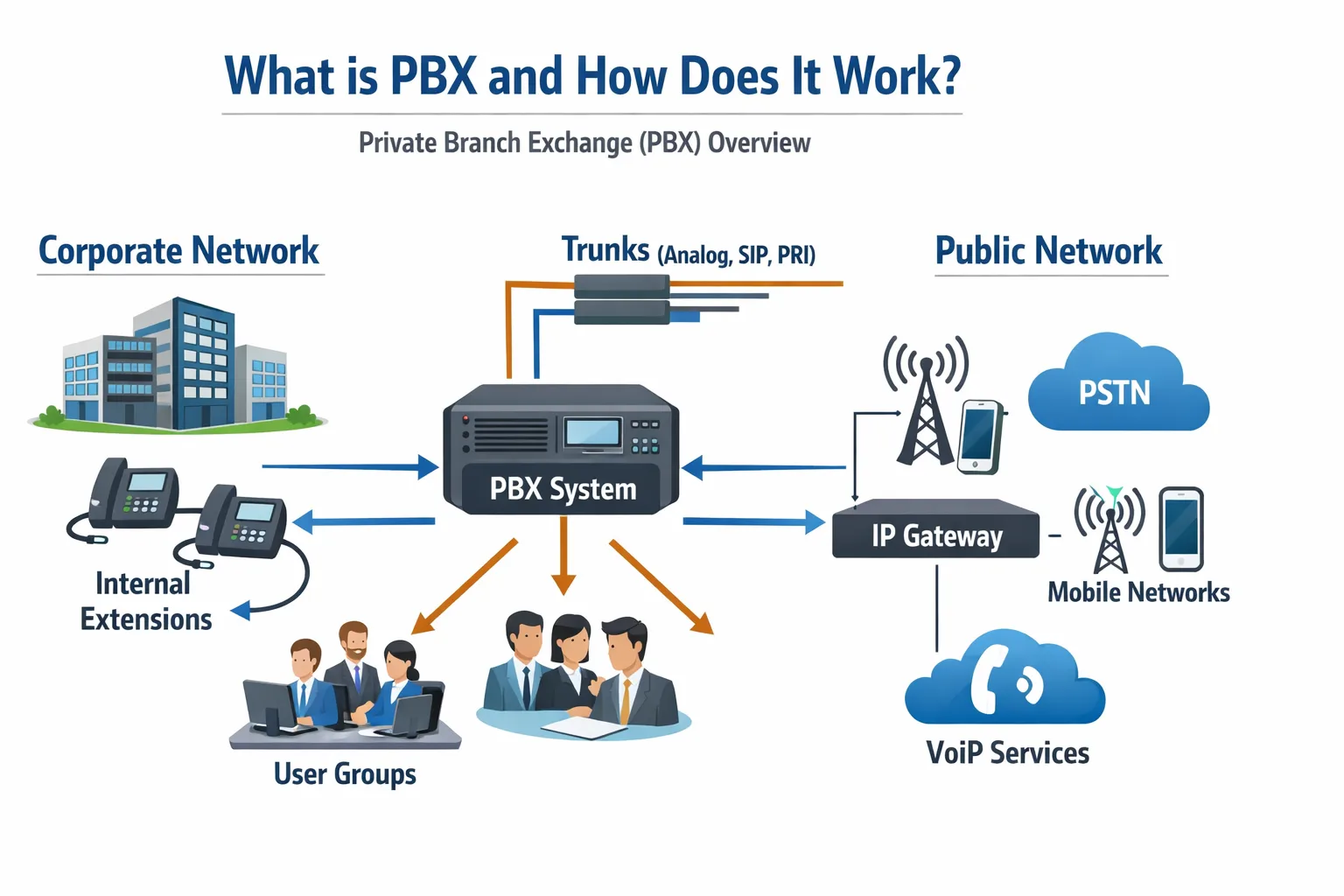
When a company expands from a single office to a multi-department or multi-site operation, voice traffic becomes a process issue. Incoming calls must reach the right team, internal users need predictable extension dialing, outside lines have to be shared efficiently, and managers need visibility over routing, queues, recordings, and failover logic. That is the context in which what is pbx and how does it work becomes important for real projects.
For business buyers, integrators, and operations teams, PBX should be evaluated in the context of actual work. The relevant questions are straightforward. How are calls routed between departments? How do office users, remote branches, and field endpoints share a common numbering plan? What happens when trunks fail, queues overflow, or a site has to support both desk phones and specialized communication devices? A useful PBX article needs to answer those project questions rather than repeat generic telecom slogans.
This page takes a practical B2B view. It looks at PBX through the lens of definition, while keeping the wider business picture in view: network structure, extension control, trunk access, application fit, user workflow, and long-term maintainability in environments such as office, branch office, reception, service desk.
Understanding the Role of PBX in Business Communication
Why PBX still matters in modern networks
PBX, or Private Branch Exchange, is the layer that organizes internal and external voice communications for an organization. Instead of every user or department behaving like an isolated phone line, the PBX centralizes numbering, routing, permissions, and policy. That is why internal extension dialing, transfer behavior, ring groups, IVR, queues, and shared outside connectivity are possible in a controlled way.
Modern communication networks may include SIP phones, soft clients, analog gateways, intercom stations, paging interfaces, remote users, and multiple carriers. The presence of IP technology does not remove the need for PBX. In practice it increases the need for strong call control, because more endpoints and more locations create more opportunities for inconsistency.
For organizations in Corporate & Public, PBX is therefore not just a telephony product category. It is a method of converting voice activity into an organized service capability. Calls are handled according to business logic rather than according to whichever endpoint happens to ring first.
What businesses are actually trying to solve
Most buyers are not searching for PBX because they are interested in switching theory. They are trying to solve common operational issues: too many public numbers, missed departmental calls, poor handoff between sites, weak after-hours handling, expensive carrier arrangements, or fragmented communication between office teams and site users. A PBX addresses these problems by centralizing the rules that determine who can call, how calls move, and where outside connectivity enters the business.
In a small office, that may mean simple extension dialing and reception transfer. In a larger project, it may include distributed branches, department queues, SIP trunks with redundancy, integration with door stations or paging, and role-based permissions. The scale changes, but the underlying purpose is consistent: communication needs a control point.
The strongest PBX projects are designed around call flow discipline first and product features second.
How PBX Works in Day-to-Day Operation
Extensions, trunks, and routing logic
The core operating model is simple. Internal users and devices are represented as extensions. These may be desk phones, software clients, analog devices behind gateways, or specialist SIP endpoints. External connectivity is provided through trunks, which may be SIP trunks, legacy circuits, or hybrid access paths. The PBX sits between them and decides how calls should move.
When a user dials internally, the PBX checks the numbering plan and routes the call to the destination extension or group. When a user dials outside, the PBX evaluates the permission class, selects a trunk route, and applies whatever digit rules or carrier preferences are configured. For incoming calls, the same platform checks the dialed destination and sends the call to reception, an IVR menu, a queue, or a direct extension based on defined policy.
This central decision-making is the reason features such as call transfer, pickup groups, overflow treatment, time-based routing, voicemail, and selective recording can operate consistently across the organization.
What a real inbound call path looks like
Consider a business that serves customers through a public main number. The carrier delivers the call to a SIP trunk. The PBX receives it, checks business hours, and then decides the next step. During working hours the call may reach an IVR with options for sales, support, logistics, and accounts. After business hours the PBX may direct urgent calls to an on-call extension while sending non-urgent traffic to voicemail or a recorded message.
That process sounds ordinary, but it is where most operational value lives. The PBX allows one number to behave intelligently under different conditions. It also allows departments to scale without publishing separate direct lines for every function. A single controlled entry point is easier to manage, easier to document, and usually more efficient for callers.
- Define user groups, locations, and call priorities.
- Document incoming and outgoing call paths.
- Check network readiness, security policy, and power strategy.
- Validate migration steps for legacy devices and special endpoints.
PBX Design Priorities for Corporate & Public
Matching the platform to the site environment
The right PBX design depends on where it will be used. An office-focused deployment may prioritize operator efficiency, mobile access, branch connectivity, and CRM-adjacent workflows. An industrial or infrastructure site may prioritize hotline behavior, paging interfaces, emergency paths, and local survivability. That is why project scoping should begin with application context rather than product branding.
In environments such as office, branch office, reception, service desk, endpoint diversity is often wider than buyers expect. A project may include standard office phones, rugged handsets, analog devices, gateways for existing circuits, or SIP-based field endpoints. The PBX has to present these as one controllable system even though the attached devices serve different roles.
Designing for the site also means accounting for power, PoE, LAN segmentation, WAN dependency, environmental constraints, and who is expected to administer the platform after handover. A theoretically capable system can still be the wrong fit if the operating model is weak.
Balancing growth, resilience, and integration
PBX projects rarely remain static. A company may open a new branch, add more service users, migrate from analog lines to SIP trunks, or connect intercom, paging, or recording functions at a later stage. Buyers who size only for current headcount often find the platform restrictive sooner than expected. Growth should be measured not just by extensions, but by devices, concurrency, sites, and integration scope.
Resilience should be evaluated in parallel. If WAN links fail, should users still be able to call locally? If the primary trunk fails, is there a backup route? If the platform is virtualized, what is the restore path? Reliable communication is an engineering outcome, not simply a specification sheet claim.
Many PBX buying mistakes begin when decision makers compare feature sheets before mapping who needs to talk to whom, when, and under what constraints.
Key Features, Benefits, and Project Decisions
Features that matter in business use
Many PBX platforms advertise long feature lists, but the most useful functions are usually the most operational: extension management, group ringing, IVR, queue handling, forwarding logic, class of service, voicemail, reporting, and controlled trunk routing. These features matter because they govern daily workload, customer response, and internal coordination.
What separates a well-chosen platform from a weak one is not the number of icons in the brochure. It is how clearly the system supports the business call model. Can administrators change routes without disruption? Are department groups easy to manage? Is branch behavior consistent? Are recordings, permissions, and emergency handling aligned with operational policy?
Benefits that show up beyond telephony
Good PBX design improves more than phone usage. It shortens manual transfer time, reduces numbering confusion, supports better service coverage, and helps departments operate under common rules. It can also reduce carrier inefficiency by consolidating trunk use and improving call visibility. For distributed organizations, it creates the foundation for a unified voice policy across locations that would otherwise behave independently.
There is also a governance benefit. Once extension plans, routing paths, and permission classes are formalized, communication becomes easier to audit and easier to maintain. That is especially valuable in organizations where service quality, operational continuity, or regulated access paths matter.
What buyers should verify before choosing
Before committing to a PBX platform, buyers should review at least four areas: real call flows, integration boundaries, network readiness, and support model. Real call flows reveal whether the platform fits the organization. Integration boundaries clarify what has to work on day one and what can wait. Network readiness determines whether user experience will match design intent. Support model determines whether the system remains manageable after deployment.
Suppliers who understand the application can usually discuss these items with precision. They will ask about departments, branches, working hours, carrier options, failover expectations, special endpoints, and future expansion. That type of discussion is a better indicator of project success than a generic feature presentation.
FAQ
Does a PBX improve internal communication only?
No. It improves both internal and external call handling by organizing numbering plans, department routing, IVR, call queues, and failover paths.
Can PBX work across multiple sites?
Yes. Modern PBX platforms can link branches, remote users, and distributed teams under one communication policy if the network and security design are planned properly.
Is cloud voice always better than on-premise PBX?
Not always. Sites with industrial workflows, paging integration, site survivability, or legacy connectivity often benefit from on-premise or hybrid PBX designs.
What should buyers evaluate first?
They should start with call flows, user roles, integration boundaries, and uptime expectations rather than brand lists alone.
If your organization is evaluating PBX for corporate & public use cases across office, branch office, reception, service desk, Beck Telcom can support planning around call flow, endpoint fit, integration scope, and deployment priorities with a practical project-focused approach.
레이블:
관련 뉴스
클린룸 전화기란 무엇인가? 통제 구역을 위한 SIP 통신
2026-09-29
통합 디스패치 시스템은 여러 통신 네트워크를 어떻게 통합합니까?
2026-09-22
2026-08-31
2026-08-24
철도 자동 호출 시스템 솔루션: 자동 호출, 확인 피드백 및 배차 연동
2026-08-17


이메일 주소:
핫라인: